


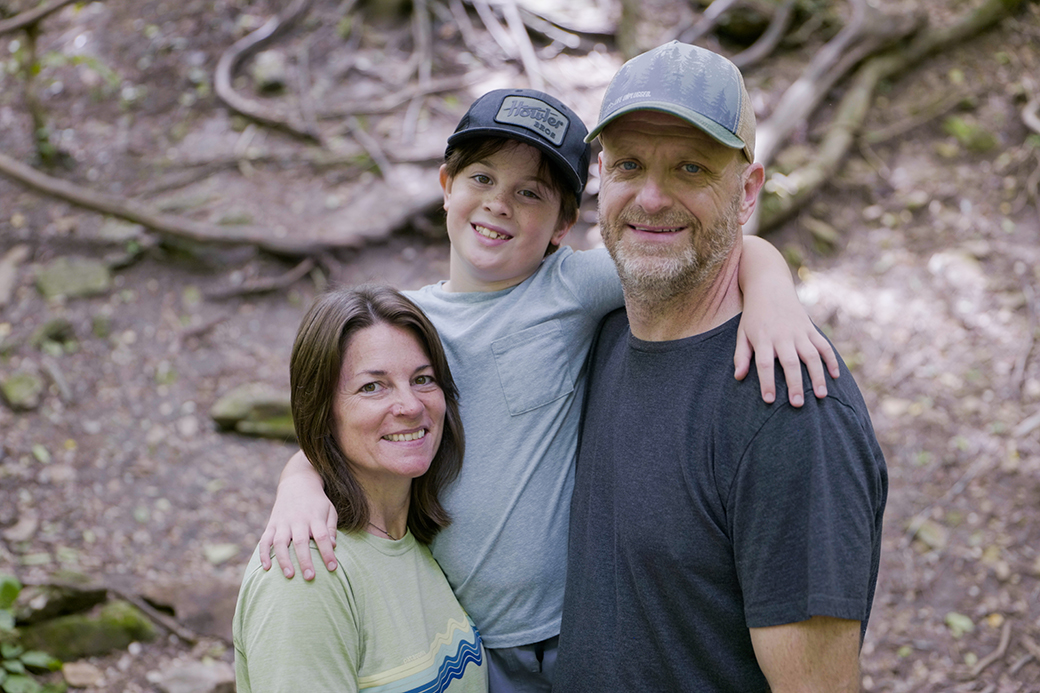
Joni Lunceford has always loved animals, flowers and the natural world.
She was an undergraduate student at the University of Missouri, studying nuclear medicine, when she discovered Rock Bridge State Park. Joni met her future husband, Kevin, at the university, and the pair bonded over their shared love for the preserve.
“This park has been part of our lives for most of our lives,” Joni said. “We built a house near it because we use it all the time, hiking the trails and exploring the caves in the summer when it’s hot.”
When she’s not gardening, hiking and enjoying the outdoors with Kevin and their four sons, Joni works as a nuclear medicine technologist at the Missouri Veterinary Health Center, a job she loves.
The Luncefords have set down strong roots in Columbia: Their home, their family, their garden. But strong roots can’t grow without care and attention to detail, something Joni gives not just to her flowers, but to herself.
Since 2020, Joni has received annual mammogram screenings for breast cancer. She started screening after talking with her primary care provider about the recommended guidelines, which start at 40 for most women.
Those scans revealed Joni has dense breast tissue, a common and natural part of anatomy. However, dense breast tissue makes it more difficult to detect breast cancer by using mammograms and increases the risk of breast cancer.
“I’ve been doing mammograms and ultrasounds every six months, and then my doctors at MU Health Care recommended we add MRI because of my risk level,” Joni said. “I had one in March of 2026, and it was negative, so I didn’t think anything of it, and then probably within a month to six weeks, I got a phone call asking me if I would like to schedule an appointment with the high-risk clinic at Ellis Fishel.”
MU Health Care’s High-Risk Breast Clinic brings detailed, personalized breast cancer screening, prevention and treatment care together in one appointment, where patients have access to both certified family nurse practitioners and surgical oncologists. MU Health Care’s High-Risk Breast Clinic sees patients at both Ellis Fischel Cancer Center in Columbia and Goldschmidt Cancer Center in Jefferson City.
Like every patient, Joni’s risk was calculated during a regular mammography appointment based on factors including family history and genetic testing. People with a lifetime risk above 20% are automatically referred, though patients can also ask their doctor for a referral or self-refer.
“Joni came to see me to talk about what it means to be high risk and what other things she could think about doing,” said Tiffany Carmichael, a family nurse practitioner and breast cancer prevention and early detection expert. “Joni’s risk wasn’t much higher than 20%, but if you’re high risk, it’s for a reason, and that should be taken seriously."
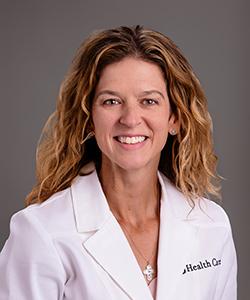
As part of the appointment, Tiffany performed a physical exam and found a lump on Joni’s right side. She ordered a diagnostic mammogram and ultrasound, which also found an abnormality on the left side.
“From the moment I sat down with Tiffany, she was comforting and reassuring,” Joni said. “At the end of the appointment, when she found the lump, she held my hand through everything and made me feel comfortable and safe that we were going to do everything we needed to do to find what's going on and make it better.”
Biopsies revealed Joni had Stage 1 invasive ductal cell carcinoma on the right side, and ductal cell carcinoma in situ, or Stage 0, on the left side. From there, she met with Nicole Nelson, DO, breast surgical oncologist, to discuss her diagnosis and treatment options.
“Our High-Risk Breast Clinic exists to help people like Joni, who we know have an elevated risk of breast cancer, reduce their risk of cancer and detect potential cancer as early as possible,” Nelson said. “Finding cancer early makes it easier to treat and easier on our patients, if we can avoid things like chemotherapy and radiation.”
Thankfully, Joni’s cancer was caught early enough that Nelson and the rest of Joni's care team at MU Health Care did not think she needed chemotherapy or radiation.
“Dr. Nelson drew pictures, gave me all the options and just had so much compassion and so much information for me to make my decisions,” Joni said. “It’s hard to believe that a breast surgeon can be that way with every patient when that's what they do all day, every day, but she was.
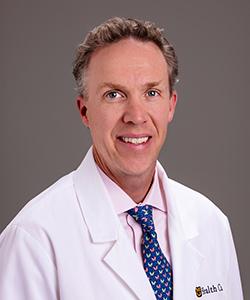
After meeting with Nelson and Eamon O’Reilly, MD, a plastic and reconstructive surgeon, Joni elected to have a double mastectomy in June of 2026, followed by reconstruction. Biopsies of her lymph nodes taken during that surgery showed no signs her cancer had spread.
“How quickly they were able to go from diagnosis to surgery is just amazing to me,” Joni said. “One month and everything was scheduled and ready and here we go. That was so helpful to me, because it's such a hard thing to deal with day by day. But I had so much support from Kevin and my family and everyone at Ellis Fischel.”
After surgery, Joni started a five-year course of hormone-blocking therapy to prevent her cancer from returning.
“For me, the importance of all of this is complementary,” Nelson said. “The High-Risk Breast Clinic has all the screening options and technology, but also people who really care. Joni’s cancer was found on a clinical exam by Tiffany, and all of these things really work together to help us identify breast cancers early and treat them early.”
Now that she is recovering and in the monitoring stage, Joni has made it her mission to make sure the women in her life, and women everywhere, are taking care of themselves, too.
“I had no reason to think that anything was wrong, and that one day, one moment changed my life,” Joni said. “The high-risk clinic is amazing, but I had no idea it existed before I got the phone call, and I am just so grateful for that. I'm so grateful that we were able to find things early, to have surgeries and put cancer behind me. I can do the things I love, I can be with the people I love and be there to support other women.”