


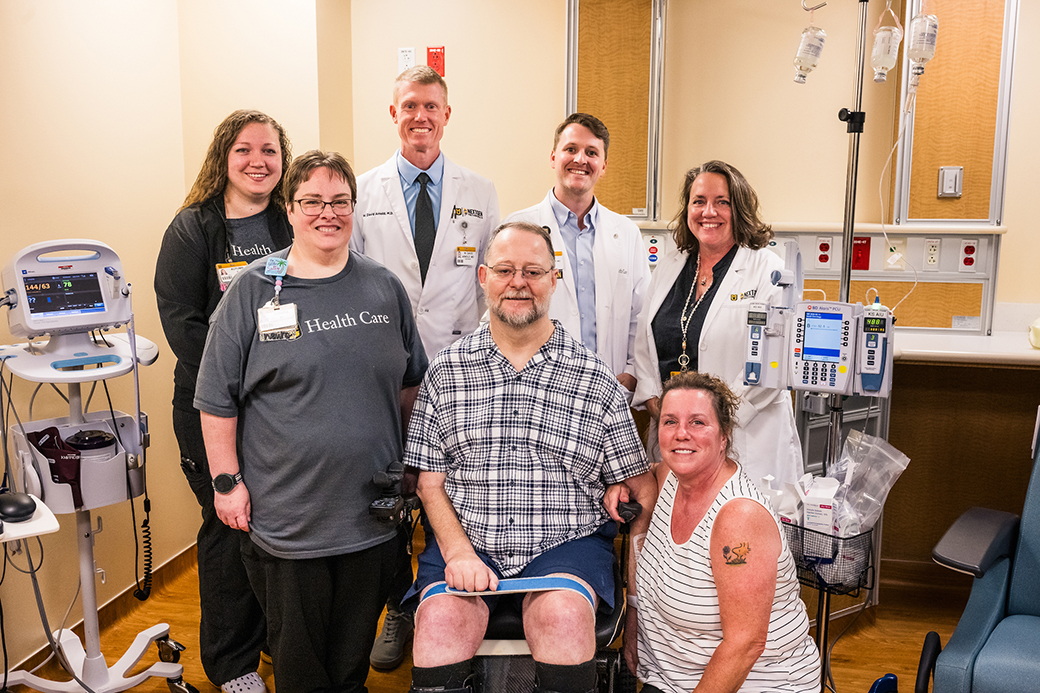
In 2016, before he turned 45, Toby Orcutt realized he could no longer drive.
He and his wife, Chris, were on their way back to Indiana after a trip to California. It was a drive they had made many times, but this time, Toby’s hip flexors were numb and didn’t respond.
“I was driving and couldn’t make it home,” Toby said. “My hip flexors wouldn’t work enough for my right foot to go between the brake and the gas. That was the last time I drove.”
It was a scary and frustrating development for Toby. He had been in shape his whole life — he wrestled and played football in high school and served in the United States Marine Corps as a helicopter crew chief, where he consistently scored near 300 on the fitness test, the highest score.
He pushed through the early signs of muscle weakness, occasional foot drop while running, at the end of his enlistment in 1995 and then started working union construction jobs back in Indiana. But his muscle weakness continued to get worse every year, and by 2001 he had to find other work.
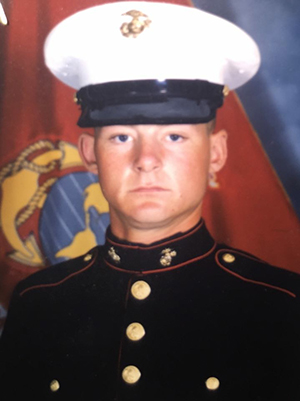
“My dad was in the union too, and I was a young, strong dude, so they loved seeing me,” Toby said. “I realized something really was wrong with my health when they wouldn't give me a job.”
Toby started going to doctors and neurologists nearby, but nobody could figure out what was wrong. He changed careers, stopped exercising and started to rely more on Chris’ help. For 20 years, each day was the same as the one before, or a little worse, as he went from walking behind a cart for support in the grocery store to needing the wheelchair cart.
“From year to year, it was figuring out how to navigate the newest, latest, greatest muscle that doesn't work,” Toby said. “Just when we get into a certain routine about one thing, something else falls apart.”
Toby and Chris moved to southwest Missouri in 2025, settling near Joplin. Toby could no longer walk, and he started having difficulty breathing. Through the VA and Paralyzed Veterans of America, he was referred to MU Health Care’s neurology clinic.
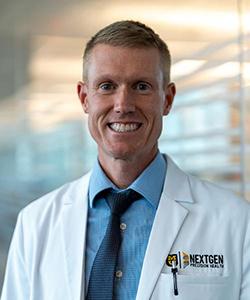
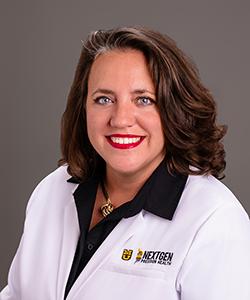
“Toby was referred for the possible diagnosis of ALS, and when we first met with him, his breathing was quite labored,” said W. David Arnold, MD, a physical medicine and rehabilitation physician and neuromuscular specialist at MU Health Care and executive director of the NextGen Precision Health initiative. “He was only able to speak a few words between bits of his story.”
After 30 years of slowly progressing symptoms, Toby had not lost hope, but he took a practical approach. An official diagnosis would mean financial support for Chris and military benefits for a funeral if his condition was deadly.
Toby and Chris brought a decade of electromyography study results — a test to measure how effectively nerve signals travel from the brain to skeletal muscles — to his first appointment.
Arnold, along with neurologists Richard Barohn, MD, and Brian Blankenship, MD, as well as neurology nurse practitioner Jaime Basnett, FNP, listened to Toby’s story, looked at past results and did testing of their own. Together, they determined that Toby did not have ALS, but an autoimmune neuromuscular condition called CIDP.
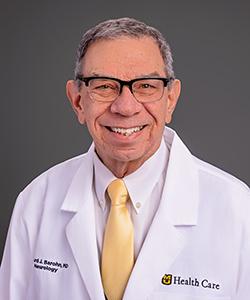
“It stands for chronic inflammatory demyelinating polyneuropathy,” Barohn said. “Some people have heard of Guillain-Barré syndrome, which has a sudden onset. CIDP is a chronic condition, where patients slowly get numbness, tingling and weakness in their legs and in their hands over many, many months.”
For reasons doctors and researchers are still trying to explain, the body’s immune system can sometimes see healthy body tissue as a threat and attack it, which is called an autoimmune disease. In conditions like CIDP, the body’s immune system attacks the protective coating of muscle nerves, and without this coating, the brain’s electrical signals can’t reach the muscles.
“It’s like the casing around a charging cable or any other wire,” Blankenship said. “The casing protects the wire and speeds up the signal, allowing it to get there. In Toby’s case, we could see where his immune system had attacked different places along that nerve sheath that prevents signals from getting through. And if left untreated, the wires inside can die off.”
CIDP is difficult to diagnose, and Toby’s version is even rarer, because his did not affect both arms and legs at the same time in the way traditional CIDP does.
“Toby's case is a subtype of CIDP that occurs maybe one in 10 cases, so where CIDP may be 10 in 100,000 people affected, his was maybe one or two people in a million,” Arnold said. “Digging through the history, we were able to see some subtle clues that made us think this was CIDP, or a variant.”
While Barohn was in residency training in the 1980s, one of his first publications as a neurologist and researcher helped other neurologists identify and diagnose CIDP. Barohn and a group of colleagues also named Toby’s form of CIDP, which they called multifocal acquired demyelinating sensory and motor neuropathy, or MADSAM.
In addition to his diagnosis, Toby’s doctors told him something incredible: His condition could be treated.
“We are fortunate to have an amazing group of neuromuscular doctors here,” Barohn said. “In the 1990s, I and a team of others did the first study that used immune gamma globulin in CIDP patients, and we showed it worked. And the next generation of physicians and researchers are carrying that torch here at MU Health Care.”
In May of 2026, Toby received his first bottles of intravenous immunoglobulin (IVIG), a blood product that calms the immune system and prevents it from attacking healthy cells.
Toby noticed a difference within hours.
“To go from not being able to walk at all, not being able to raise my arms over my head, to getting these treatments, I feel really good,” Toby said. “I can walk better than I could four or five years ago. Chris did so much to take care of me, and little by little, I’m starting to take little pieces back off of her plate.”
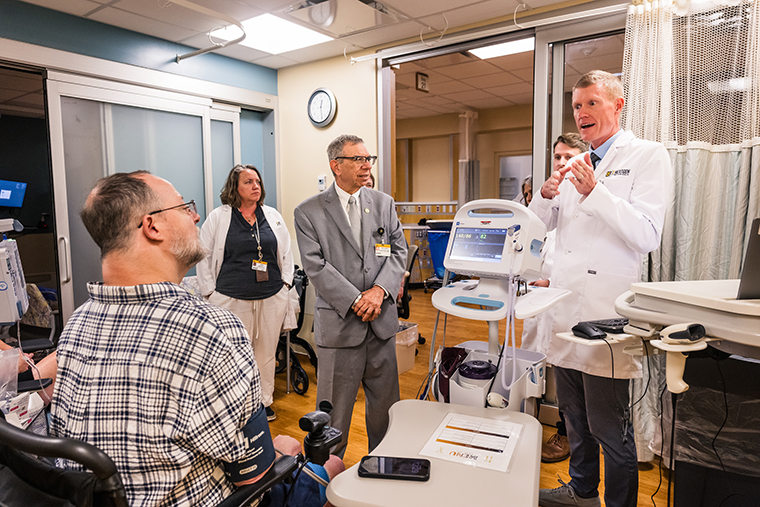
He also regained some control of his hip flexors, which makes him hopeful he can return to driving.
Because CIDP is rare, there is still a lot that neurologists don’t know about the condition. No one on Toby’s care team has treated someone who had symptoms progress for as long as his did, and nobody knew what to expect from treatment.
“I’m a pathological optimist, so I had high hopes, but I told Toby I honestly didn’t know what to expect,” Arnold said. “The fact that we are seeing positive effects that appear lasting is very encouraging. Our team of neuromuscular specialists is focused on finding solutions for these tough problems, and I hope Toby continues to improve.”
Chris noticed a dramatic change in her husband’s physical health, but also his mental health.
“He thought he was dying because he was getting worse for so long, and he was in a rush to do this and do that so I’d be taken care of,” Chris said. “From this first treatment, everything changed so much for the better because he can enjoy life now.”
Toby will continue monthly infusions and is excited to get back to physical therapy now that he is regaining some control of his muscles. He has lots of goals, including getting back out to California to watch his Denver Broncos play in Los Angeles, going to graduate school and keep building a life with Chris.
“If I hadn’t come to MU Health Care, I don’t know what things would look like,” Toby said. “Before, I was making plans because I might not be here. But I'm not looking down making plans now, I'm looking forward. I’m planning for tomorrow.”