


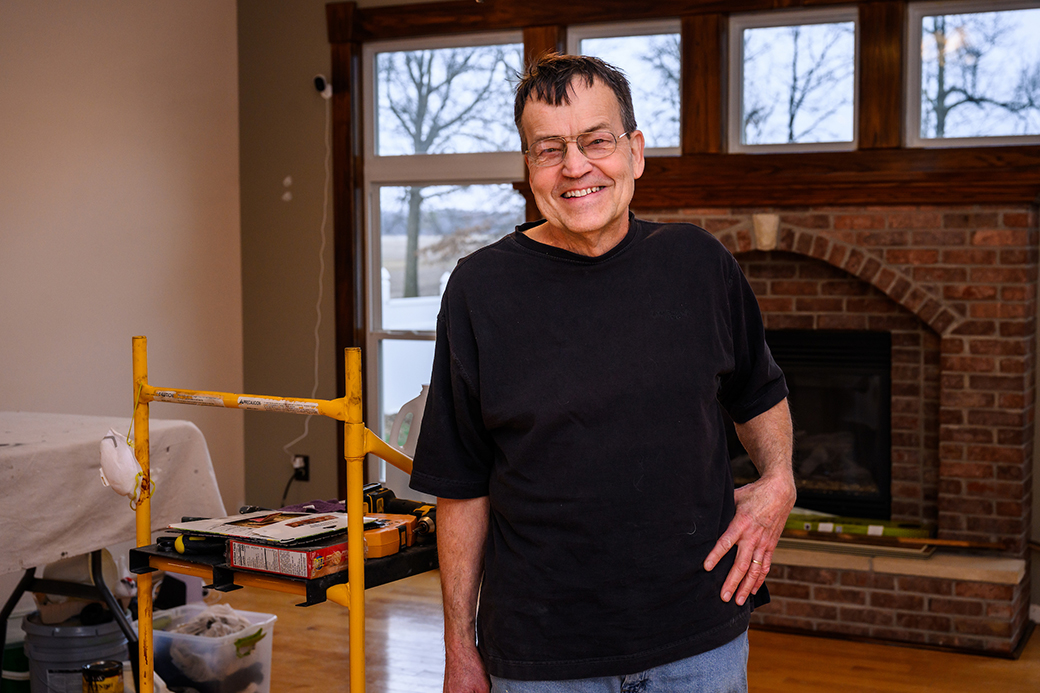
Randy Brunken is someone who likes taking time to do things right.
He and his wife, Deb, work together as do-it-all interior wizards — painting, staining, varnishing, wallpapering and cleaning houses in and around their adopted home of Moberly, Missouri.
“We help people make spaces beautiful,” Randy said. “Lots of attention to detail and specialized work, which means we can be selective about our projects.”
He always has time for Miss Bella, the family’s yellow lab, taking her on regular walks and hikes through Moberly’s parks whenever he needs a break or a mental reset.
“She's pretty much the ruler of our house,” Randy said. “We love her, and she brings a lot of joy. Her walks are my therapy time.”
Randy realized how important his family, his craft and his walks with Bella were to him when activity became more difficult around the holidays in 2023. Chest and rib pain that he hoped would pass with rest never did.
In May of 2024, Randy went to his primary care doctor in Moberly, and then MU Health Care in Columbia.
“It was very difficult for me to take even a fourth of a breath in,” Randy said. “I had come to the conclusion it was a rib issue, and I didn’t need a referral to see someone about it at University Hospital, so I went and found help there. My appointment started at 9 a.m., and it was almost 6 that evening when I left.”
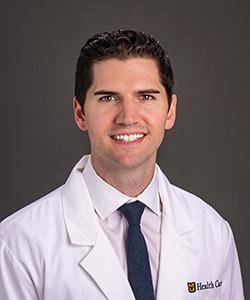
Randy’s initial CAT scan and consult with orthopaedic surgeon Douglas Haase, MD, showed he had three broken ribs without any injuries. That was a reason for Dr. Haase to investigate the signs that Randy’s bones were weaker than normal.
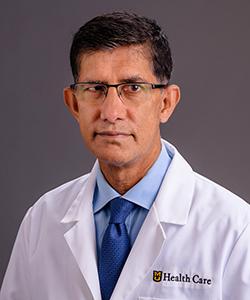
After some blood testing and a bone marrow biopsy, Randy and Deb sat down with Cherian Verghese, MD, an expert in bone cancer and cancer care at Ellis Fischel Cancer Center.
“When we looked at Randy's test results, it seemed like there was an abnormal protein in his blood, which made us look into the cause of his broken ribs further,” Dr. Verghese said. “The biopsy completely changed the way we approached his bone pain, from a local problem to a cancerous one.”
Randy was diagnosed with multiple myeloma, a rare blood cancer of plasma cells. There are about 35,000 new diagnoses in the United States each year, mostly in people older than 50.
“Myeloma” refers to the space inside the bone marrow where healthy — and sometimes cancerous — blood cells are made, and “multiple” means that the condition affects more than one bone.
“Initially, it was a surprise to my wife and I, and we were concerned,” Randy said. “By the time we left that day, we were reassured that they would do everything they could to treat it.”
Randy started radiation therapy quickly at Ellis Fischel to help with his pain and to shrink the tumors. If left untreated, multiple myeloma will prevent the body from creating healthy blood, leading to anemia. And the breakdown of myeloma cells causes kidney problems, which then leads to kidney failure.
Recent advancements in treatment, however, have given patients potential for longer remission, and physicians like Dr. Verghese hope the condition can be completely cured in the near future.
“Myeloma becoming treatable was a big advancement in medicine and cancer treatment,” Dr. Verghese said “What’s changed in the last 10-15 years is the number of targeted treatments, or immunotherapies, now available. This gives patients more options and means that we are moving away from chemotherapy and its broad side effects to drugs that can have fewer side effects.”
After finishing radiation, Randy started monthly infusions of four drugs that targeted myeloma cells directly. The medications strengthened his immune response, flagged cancer cells for his immune system and blocked the cellular function of the cancer cells, causing them to die off.
Dr. Verghese also told Randy that he was a candidate for a transplant of his own stem cells, a new treatment option through the Blood and Marrow Transplant and Cellular Therapy Center not available anywhere else in mid-Missouri.
“Doing this stem cell procedure in Columbia was a huge, huge encouragement to us,” Randy said. “Being closer to home, not having Bella at the house by herself all day and Deb not having the stress of driving in a big city — that peace of mind really meant a lot to us at that time.”

In December of 2024, Randy was one of the first patients at MU Health Care to receive a transfusion of his own stem cells, also called an autologous transplant, for myeloma. Patients take a medication that increases their stem cell production, and the extra cells are collected in the same way as a blood or plasma donation.
Radiation and immunotherapy happen in a stage of treatment called induction. This is the first step, and the goal is to destroy as many cancer cells as possible. Stem cell transplant is a secondary treatment phase, called consolidation, and often comes just after a strong chemotherapy infusion, replacing both healthy and unhealthy marrow cells with ones that doctors know are healthy.
“Stem cell transplant has been shown to be a very effective form of consolidation,” Dr. Verghese said. “For patients like Randy, that consolidative regimen deepens the body’s response to induction. Whenever possible, we consolidate the initial treatment of myeloma with an autologous stem cell transplant to extend remission.”
Randy developed a close relationship with his care team, and he and Dr. Verghese rarely ended an appointment without a shared laugh. Randy’s stories made Bella famous throughout the unit, but it was hard for the pair to be separated at Christmas while Randy’s immune system recovered from the transplant.
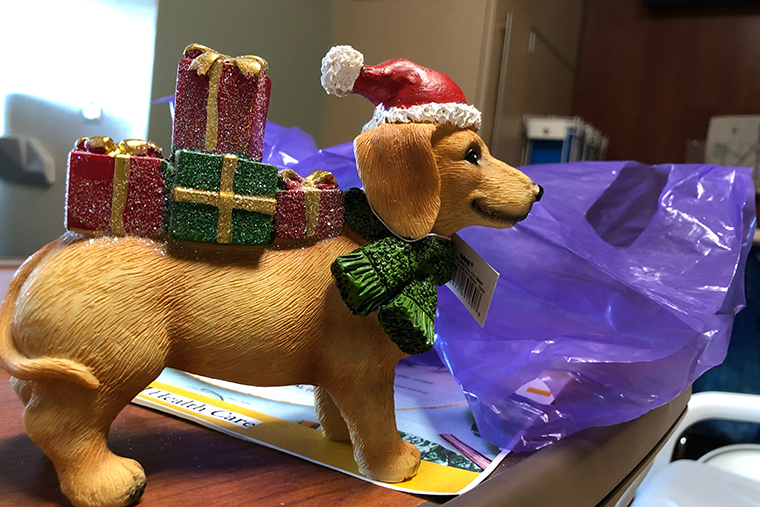
Recognizing this, one of his doctors brought Randy a Christmas-themed yellow lab figurine as a gift to lift his spirits.
“I thought that was just above and beyond,” Randy said. “I am so grateful for the people I experienced in the hospital. There was an extreme amount of compassion.”
Advanced immunotherapy treatments for cancer often require extended hospital stays. Patients are kept in isolation to lower their chances of getting sick when their immune systems are at their lowest.
“Being away from home for a month or even more is not an easy choice to make, and bringing these treatments to mid-Missouri is a great benefit for patients,” Dr. Verghese said. “Around Christmas, we were all trying in different ways to make it seem like this was home away from home for Randy. Giving him the lab figurine was a way to say, ‘Hey, we are here to support you. It's only a few days, and we'll get you back to Bella.’”
After his stem cell transplant, Randy returned home to Moberly in remission with no evidence of cancer. He, Deb, Dr. Verghese and the rest of his care team will keep a close eye on his follow-up scans to make sure his myeloma stays away, and act quickly if it returns.
Randy has returned to the things he loves, spending time with Deb and Bella and working with his hands, with a newfound appreciation for everything — including time.
“I have experienced care in other world-famous hospitals, and I would put MU Health Care and Ellis Fischel equal to or above those,” Randy said. “We have world-class care right here at home, and I’m so grateful for the people there. I relish every minute I have to experience life, and now I spend my time with what really is the most valuable.”