


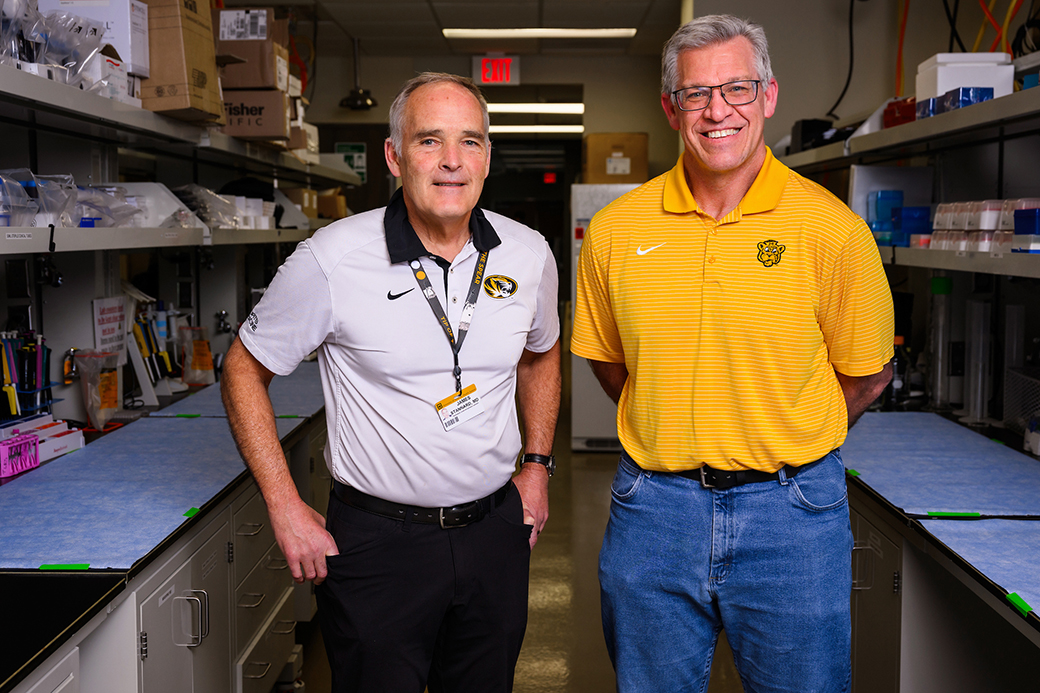
As Aaron Stoker, PhD, watched the Missouri Tigers lose in the Big 12 men’s basketball tournament from his home in Columbia, his reaction wasn’t one of frustration or disappointment.
He felt relief and a little excitement. The year was 2011, and Dr. Stoker, a three-time University of Missouri graduate, had a good reason to feel happiness after a Tigers’ loss. He was scheduled to have knee surgery the next morning, and his surgeon, James Stannard, MD, was also the team physician for Mizzou hoops.
“There was some concern that, if the Tigers won the game, he wouldn’t be able to come back to Columbia to perform the surgery,” said Dr. Stoker, now the director of the Thompson Laboratory for Regenerative Orthopaedics. “Thankfully, that didn’t happen, he did a great job, and I’ve had the graft for 16-plus years now.”
An unexpected injury had destroyed the healthy cartilage in his left knee.
“I was stepping out of the car, and I felt a pop in my knee,” Dr. Stoker said. “Part of the cartilage and bone at the top of my femur just separated.”
Because he was in his 30s and very active, joint replacement surgery was not an option for Dr. Stoker. Instead, he would need to replace his cartilage with donor tissue, called an osteochondral allograft transplantation.
At the time, Dr. Stannard and Dr. Stoker faced a very specific time crunch — one that Dr. Stoker, Jimi Cook, DVM, PhD, and a team of scientists at the University of Missouri had spent years trying to solve.
Osteochondral allografts were a proven and established treatment for cartilage repair in damaged joints. But like all donor tissue, there is a window of time cartilage can survive outside the body, and each sample needs 14 days to pass laboratory tests for safety.
“The earliest a patient could get one is 15 days, and by our standards and research, we weren't willing to take one over 21 days,” Dr. Stannard said. “You only had a six-day window to match it and implant it.”
Dr. Stoker had been on a waiting list for an osteochondral allograft for six months and wanted to get back to playing basketball with his son and recording his kids’ band concerts pain-free. He remembered matching on Tuesday or Wednesday and scheduling surgery that Friday.
“I would not have had the surgery on the following Monday because I didn’t want the graft to be that old,” Dr. Stoker said. “I knew the science of it. The chance the graft would fail would have gone up dramatically just over the weekend.”
A Missouri Solution
A few years later, Dr. Stoker, Dr. Stannard and the team at the Missouri Orthopaedic Institute published a solution to that same time crunch he experienced.
They had created a new method for preserving these tissue donations. This new system kept more of the cells that create and make up healthy cartilage, called chondrocytes, alive by using a liquid designed for that purpose.
The results showed their method nearly tripled the total time the tissue donations could be stored before they were used. This gave surgeons and patients much more time to successfully implant new knee cartilage.
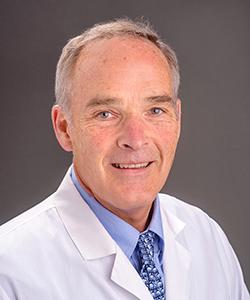
“When we started this, about 70 or 75% of grafts were thrown away without being implanted, because after 21 days they were below the viability threshold,” Dr. Stannard said. “Now, it’s flipped, and we’re implanting about 75% of donor grafts.”
The Missouri Osteochondral Preservation System™, or MOPS, uses a carefully formulated solution and stores the tissue at room temperature. This keeps more chondrocytes alive longer and increases the rate of a successful procedure significantly.
“In the process of developing MOPS, we have done studies that established a benchmark that 70% is the magic number,” Dr. Stannard said. “You have to have 70% of these chondrocytes, these little factories, remaking cartilage to keep the graft alive.”
MOPS preserves up to 98% of chondrocytes for between 40-55 days, while older methods of preserving these donor tissues kept less than 25% of chondrocytes alive at 21-28 days.
“Clinicians and patients just have more time to put everything in place,” Dr. Stoker said. “You don’t have to drop everything immediately, out of nowhere, to go into surgery. I can only imagine that now it’s less stressful and easier to prepare for than what I went through.”
A chondrocyte allograft is an ideal procedure for someone who has little to no healthy cartilage in their knee but is too young for an artificial joint.
If arthritis or an injury damages the joint cartilage badly enough, an allograft can re-enable the body to regenerate healthy cartilage more quickly than it is damaged.
“Cartilage is really an incredible thing, because it’s a solid, but it is a thousand times more slippery than ice,” Dr. Stannard said. “Having healthy chondrocytes is how your joint stays healthy and keeps you from needing a joint replacement.”
A Gift Around the Globe
Dr. Stoker and Dr. Cook patented the MOPS solution and signed a deal with a tissue bank and medical device company to bring the technology beyond Missouri. MOPS is now used in more than 400 medical centers throughout North America.
“To me, it’s important and gratifying that patients that didn’t have that option now do,” Dr. Stoker said. “That means a lot to me.”
Institutions can use MOPS for a licensing fee, or for free if it’s being used by a nonprofit organization for research or education. This approach has helped expand the reach and impact of MOPS internationally.
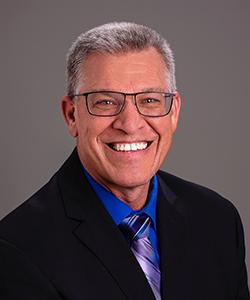
One of those locations is Thailand, a country of 74 million people more than 8,500 miles from Columbia. MU School of Medicine faculty have a longstanding relationship with their Thai colleagues, exchanging ideas and information about patient care and research.
“I was speaking with a surgeon who was interested in MOPS, but Thailand didn’t have access to the grafts,” Dr. Stannard said. “He connected us with the Thai Red Cross, which also handles organ and tissue donation there, and they were the perfect partner.”
Once an agreement was struck, Dr. Stannard and Dr. Cook traveled to Thailand in January of 2025. They showed Thai surgeons and medical staff how to mix the solution, how to collect the donor tissue and how to implant it.
Thai doctors made a return trip to the U.S. later that year to visit the tissue bank, as well as the School of Medicine’s research labs in Columbia, to learn more about storage and surgical techniques.
“The health care in Thailand is quite good, and we chose the Thai Red Cross because their standards are high,” Dr. Stannard said. “We knew they were going to do it right and do it well, and they only needed a little guidance.”
Since the start of 2025, Dr. Stannard estimates MOPS has been used in about 20 meniscus transplants in Thailand, and that the Thai Red Cross plans to perform their first osteochondral allograft in 2026.
The Future of MOPS
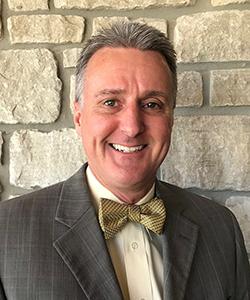
As Dr. Stoker recovered from his cartilage transplant and finished physical therapy, he decided to honor his gift by preserving it as much as possible. That gift allowed him to be an active dad — playing driveway basketball with his son, cheering on his kids’ high school band performances — as well as pain-free movement in daily life.
It also meant his work on improving MOPS didn't slow down.
“We’re looking at ways to monitor the health of grafts and even extend the storage life beyond 58 days,” Dr. Stoker said. “I’m grateful that my graft has worked for me for 16 years, and we want to improve the odds of each gift being used.”
In addition to ongoing research, Dr. Stannard is optimistic about partnering with more nonprofit groups to bring this incredible advancement to more people.
“There are a lot of steps between, ‘Hey, here's this fluid,’ and, ‘Hey, it's ready to put in your patients,’ Dr. Stannard said. “We have learned a lot about how to perform these procedures successfully, and MOPS has been a big part of that. The door has been opened, and there's been a nice exchange that's gone on in addition to getting the transplants available to an entire nation.”