


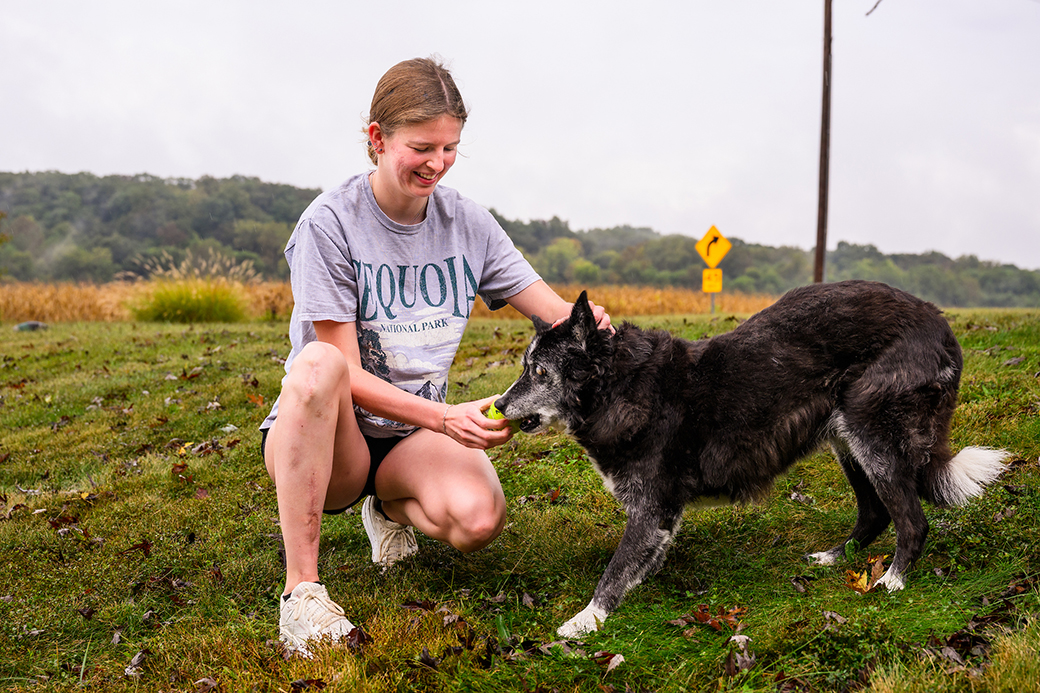
The front yard of her parents’ home in Harrisburg, Missouri, is a place full of memories for Madeleine Gillman.
A tire swing hangs from the elm tree on a small rise looking over fields and hills. It’s where she practiced playing soccer at first with her parents, and then with her dog, Sophie, a Christmas present when she was 10.
“Soccer is just something I’ve always enjoyed,” Madeleine said. “I loved the team atmosphere, the practices and drills, competing against friends. Just being outside on grass and having fun is something I loved.”
As a defender, Madeleine’s dedication to the sport throughout her school and club careers earned her the opportunity to play at Southwest Baptist University. There, she found a home away from home and started turning her passion for anatomy and physiology into a career as a nurse.
But an unfortunate streak of injury luck meant that her breaks from school and soccer required dedicated rest and recovery.
“The highs of college soccer were all the time spent in practices and at games with my teammates bonding,” Madeleine said. “The low was that I got injured almost every season — I got to know my trainers really well, and I’m still friends with one today — but my career ended in another injury, a chronic stress fracture.”
Madeleine’s injury, also known as a shin splint, was a tiny fracture in her right tibia, the main leg bone below the knee. The injury was painful enough, and had reoccurred enough, to need surgery.
Madeleine had her surgery during Thanksgiving break in 2022 and hoped to spend the time at home. She was looking forward to relaxing with her parents, sister and Sophie, recovering and studying for her nursing licensure exam.
But a complication during surgery to fix her bone turned her life upside down.
“I had a nerve block for the surgery, and after about a week I still didn’t have feeling back, which made me confused,” she said. “When the blister from the burn mark popped, it was gross, honestly. It looked like dead tissue.”
Madeleine called her surgeon, who recognized something had gone wrong during the surgery and referred her to MU Health Care’s Limb Preservation Program. The program brings together doctors, nurses, imaging and diagnostic experts and more to prevent amputation when possible and optimize prosthetic limbs.
Madeleine’s referral came to Brett Crist, MD, the program’s co-director and an expert in fracture care and bone infections.
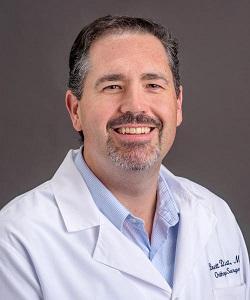
“It’s a very routine procedure that unfortunately didn’t go as it should have,” Dr. Crist said. “Madeleine had some bone and skin loss, which led to a chronic wound and then infected and dead bone. Thankfully, her referral to us was very quick and we were able to get moving on treatment.”
The words “necrosis” (a large amount of dead tissue) and “osteomyelitis” (a bacterial bone infection) are scary to most patients, even ones on the cusp of completing nursing school, which Madeleine did in the spring of 2023.
“It was definitely a shock,” Madeleine said. “Nothing prepares you for watching your skin get dug out to see your bone, but I do think that my nursing career really prepared me.”
Days after Madeleine graduated, Dr. Crist’s team surgically removed a three-inch section of dead bone in her right tibia.
“We removed the unhealthy bone to address the infection and to get to healthy bone that can regrow,” Dr. Crist said. “It was essentially like taking a section of pipe out.”
Madeleine's team, which included infectious disease and vascular experts, placed a temporary metal rod coated in antibiotic medication to finish clearing the infection.
Seven days later, Dr. Crist took her back into the operating room and placed a bone transport system on her right leg. This technique relies on the body’s ability to regrow bone naturally and uses a fixator plate, a rod inside the bone that bridges the gap, and a set of magnets. The system slowly pulls a section of healthy, growing bone to the other side of the cut.
Madeleine used a strong external magnet twice a day, every day, for weeks to slowly move the bone to stimulate the growth of healthy bone to close the gap.
“Thankfully I had already seen the treatments they used in other patients as a nurse,” she said. “That gave me a little bit of peace.”
Orthopaedic and microvascular surgeon Julia Nuelle, MD, and Dr. Crist performed a bone graft and muscle flap procedure to ensure the new bone had a good blood supply, carefully moving healthy skin and muscle to cover the rest of her leg wound.
“I think we're really lucky to have everything that we have here for patients,” Dr. Crist said. “Our program is unique in the Midwest in terms of the services we provide and the way we approach limb preservation. We always have to talk about potential for limb loss, but with Madeleine’s specific situation, I was confident we could find a way to save her leg.”
Madeleine exhaled after her wound was closed.
“After the skin graft, I finally didn’t have a wound anymore,” she said. “That’s when I started to share Dr. Crist’s optimism that I would keep my leg. Without him, I wouldn’t have it.”
Madeleine was thankful she got to stay with her parents in Harrisburg during treatment, which meant she was closer to her doctors in Columbia and had support at home when she needed it. Her recovery included 10 months on crutches as she worked toward working in a hospital.
“I loved how everyone talked to each other outside of my visits,” Madeleine said. “I went to my appointments, my doctors were there, and there wasn’t much waiting. It sped everything along and felt like I was really being taken care of by everyone.”
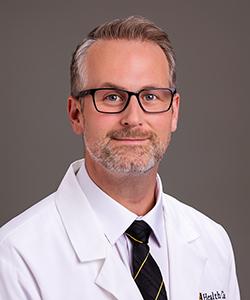
Dr. Crist and orthopaedic surgeon Sébastien Lalonde, MD, performed a final surgery in the spring of 2024 to convert her bone transport nail to a permanent nail.
Madeleine started physical therapy and aquatic therapy soon after and has been able to keep up with the demands of an ER shift. She has her sights set on even bigger goals: Training for marathons and triathlons.
“The fact that she's able to work a full shift on her feet as a nurse is pretty remarkable,” Dr. Crist said. “It speaks to her as an individual and that support from her family, but also that she's continuing to improve from a bone standpoint and rehab standpoint.”
Madeleine is also able to bring a personal touch to her nursing practice that not even school could have taught her.
“It's already helped me in patient care, and I think it gives me a little more empathy towards all of my patients,” Madeleine said. “I've had a few patients with bone infections and it's not looking good, and being able to say, ‘Hey, I've been through something similar and I’m still walking, it’s okay.’ That's always nice.”