



There’s a lot happening in Elsie’s world, and the smiley 4-month-old is interested in all of it.
“She is so curious about everything,” said her mother, Kylie Routh. “She’s always looking around, taking in everything happening around her.”
Watching her daughter enjoy her toys and older siblings, Kylie remembers a time when she couldn’t imagine bringing her home. At just 17 weeks into a twin pregnancy, Kylie lost one of her babies, Elsie’s twin sister, Calla.
“When my water broke, I truly thought I was losing everything,” Kylie said. "I didn't know what was going to happen next."
But at MU Health Care, maternal fetal medicine specialist John Richard, MD, offered an option Kylie hadn’t known was possible — a procedure called a cervical cerclage. Dr. Richard explained that he could place a stitch around the cervix, the lower part of the uterus, to help hold it closed and give Elsie more time to develop. But he couldn’t promise it would work. Placing the stitch could break Elsie’s amniotic sac and bring on an early delivery.
Kylie could also wait to see whether the pregnancy would continue on its own. Elsie’s sac was still intact, but Kylie’s cervix had already opened. Even if she skipped the procedure, she could still deliver too early for Elsie to survive. After weighing both options, Kylie decided the chance to give Elsie more time was worth trying the stitch.
“I was absolutely terrified, but I knew I had to give her every chance I could,” Kylie said. “So, I took the chance. I’m glad I did.” Dr. Richard has spent years helping patients weigh the risks and benefits of a cerclage. He drew on that experience as he talked through the options with Kylie. “I have never put a stitch in that I regretted putting in,” Dr. Richard said.

Kylie’s cervix had already opened about 4 to 5 centimeters when Dr. Richard placed the cerclage. He could see Elsie moving through the membrane surrounding her. Dr. Richard compared the procedure to pulling on a drawstring at the top of a purse — as he tightened the stitch, the opening closed.
Kylie went home the next day after staying overnight for monitoring. At 20 weeks, she returned to MU Health Care for a detailed ultrasound. Elsie was developing, and the stitch was holding.
“And I think at that point, I think she realized that Elsie had a shot,” Dr. Richard said.
Kylie continued seeing her regular OB/GYN, Mary Faurot, MD, at Jefferson City Medical Group. Dr. Faurot stayed in touch with Dr. Richard at MU Health Care so Kylie could get routine prenatal care close to home and make fewer trips to Columbia.
“At the beginning, I had little hope,” Kylie said. “But as time went on and we kept making progress, I started to believe that maybe everything was going to be okay.”
When Calla miscarried at 17 weeks, it was too early for either baby to survive outside the womb. The stitch held long enough to give Elsie about 16 more weeks to grow and develop. At 33 weeks and two days, Kylie’s water broke again. She delivered Elsie by C-section at MU Health Care’s Birthing Center in Columbia.
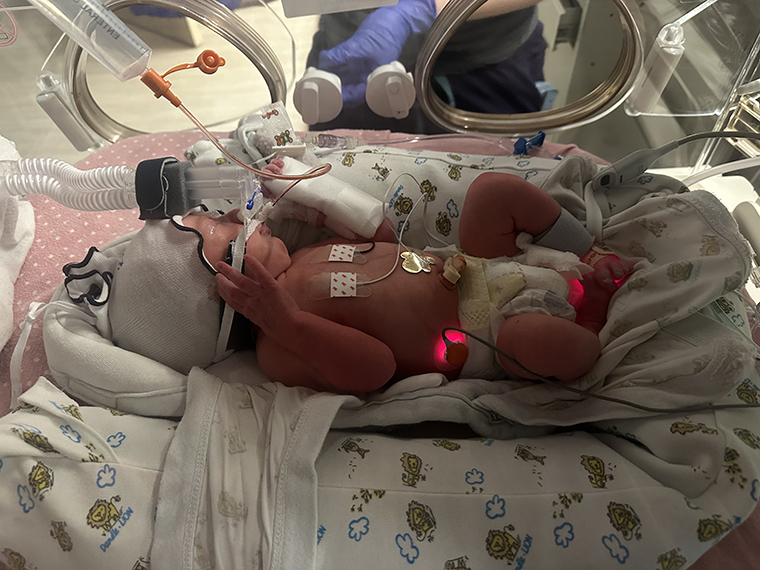
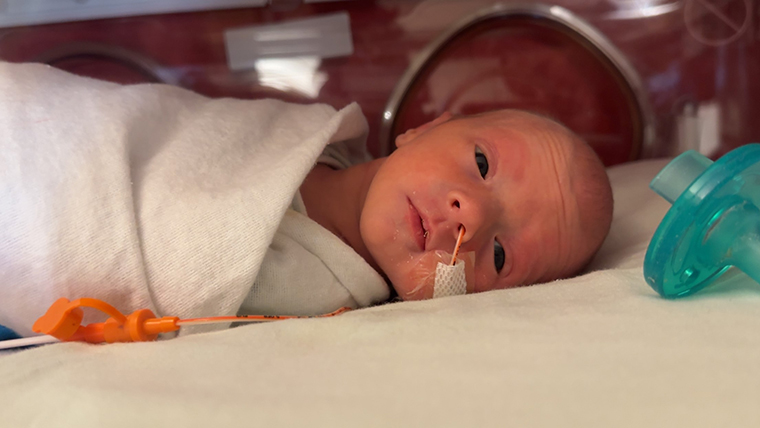
Elsie was still premature and needed care in our neonatal intensive care unit, but she was able to go home with her family after her stay and is now meeting the developmental milestones her care team expects for her adjusted age. For Dr. Richard, that was what made those extra weeks so remarkable.
“This is a grand slam home run,” he said.
Now Kylie can watch Elsie enjoy her siblings and show more of her personality each day. “More than anything, I just hope that she stays healthy and gets to grow up experiencing all the everyday moments and little things that every child deserves,” Kylie said.