


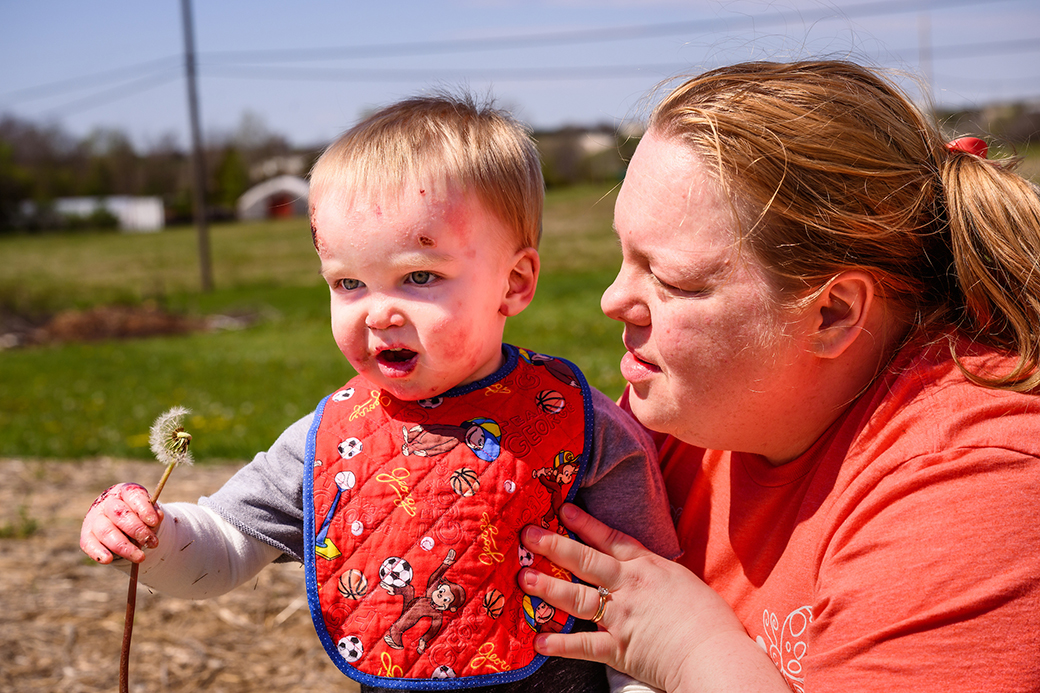
Each morning when he wakes up, Matthew Jones’ parents check every inch of his skin.
Jessica and Andre Jones are looking for welts, bruises or wounds, which happen so easily in the day-to-day of being a young boy that checking has become routine.
“Friction causes him to get wounds, so does pressure,” Jessica said. “It doesn't take much. A small fall or rubbing his head in bed when he sleeps, he can rub himself raw.”
Matthew was born with a rare genetic condition called epidermolysis bullosa, or EB. It’s also called butterfly skin, because it causes skin to be very delicate, like a butterfly’s wings.
“He's wild. He's like a normal 2-year-old, but he's fragile,” Jessica said. “You can't tell a 2-year-old to be careful, so he runs, jumps, climbs anything someone his age would. He's very silly.”
The condition occurs in about one in every 50,000 babies born in the U.S. Matthew’s form of EB is even rarer: His body does not produce any Type VII collagen, which acts as the glue that holds the top layer of skin to the next layer. That makes Matthew one in 330,000.
Jessica had a normal pregnancy, and had family with her at MU Health Care’s Birthing Center in Columbia when Matthew was born.
Because the Birthing Center is co-located with Children’s Hospital, her doctors in the labor and delivery room had access to specialists right away, including pediatric dermatologist Kari Martin, MD.
“We found out the day that he was delivered,” Andre said. “We spoke with the hospital dermatologist who said it looked like this genetic disease, butterfly skin, and a test confirmed it. I didn't have anything to be scared about yet because I didn't really know anything. All it was was a name.”
Jessica, a registered nurse herself, and Andre learned many names and faces in the next three days while Matthew was stabilized in the NICU. One of them was pediatric dermatologist Kimberly Eisenstein, MD, who became his primary specialist.
“Matthew got a lot of attention in the NICU. Not because he was sick in any other way, but because it takes a lot of education for nurses to know how to care for him without damaging his fragile skin, and his parents becoming comfortable feeding him and holding him and changing his diaper,” Eisenstein said. “We have come up with a protocol for him so when he does come to any part of our system, there's an alert that lets people know that he needs care a little bit differently.”
Jessica and Andre have their own protocols at home. They are there to catch Matthew if he falls and have baby gates up not only to protect him from the stairs, but from hard floors. Matthew sleeps on sheets made of bamboo rayon, which are gentler on his skin, and his parents try to get toys without sharp plastic edges.
“His personality, in spite of what he deals with, is a high point,” Andre said. “We were afraid for a long time that he would just be in pain and burdened with it all the time and not be able to kind of come out of his shell, but he has.”
For Matthew, that means loving toy trucks, or anything with wheels. It means begging to go to the park and crying when it’s time to go home. He loves people and is excited to make new friends, including the people on his medical team.
“Matthew's pretty amazing,” Eisenstein said. “He really lights up the room. He is smart and full of joy and very curious. His smile encourages the people around him to rally. One day in clinic, Jessica was changing his dressings, and he was a little fussy. All of a sudden, seven or eight adults — myself, medical students, residents and nurses — started singing him nursery rhymes, every single one of us with the hand motions included, just to distract him, just to make him giggle and smile.”
Those interactions are common for Matthew, because his clinic rooms are often full of doctors and nurses. EB does not have a known cure yet, and Matthew receives ongoing care to manage his symptoms and keep his skin as healthy as possible.
That starts at home with daily dressing changes, which help Matthew’s skin heal and reduce his increased risk of infection. The process can be painful, but as Matthew has gotten older, his parents have noticed he’s started helping when his arms or legs are covered.
Dr. Eisenstein and his pediatrician, Katie Guymon, DO, help coordinate his routine and complex care needs, which includes medication for his pain and itching.
“One of the advantages to having all of his care in one place is that we can easily access each other and get real time feedback, real time collaboration,” Eisenstein said. “Dr. Guymon can ask me to take a look at a wound after Matthew visits her, or I can contact the pain care team about his dosage. We have video conferences about him, about managing some more of his complex problems, and I don't think that would be possible if he had to have all of his care in different places.”
In addition to routine dermatology and primary care clinics, Matthew gets dietary and nutrition support, surgical consultations for his feeding tube, checkups for his eyes and heart and speech therapy to help him eat. His pediatric complex care team includes social workers who help Jessica and Andre work with insurance to get the care he needs.
“I really like that they all communicate together and that they’re so caring,” Jessica said. “And I’m so grateful that we’re able to stay here. All of the providers communicating together and working together for him, not just doing their own thing separately, has really helped shape the care that he's getting. I couldn’t ask for anything better.”

Andre and Jessica know that Matthew’s life is different, and will continue to be different, than kids his age. Researchers are exploring new treatments for EB, and care for kids Matthew’s age already looks different than it did 10 years ago as parents, kids, doctors and nurses learn more about the condition.
“In many ways, my biggest hope for him is just being a normal kid in as many ways as possible,” Andre said. “For all I can tell he’s a normal kid. He's just a great kid, and I love him. He's just doing what a kid does and not letting anything stop him.”