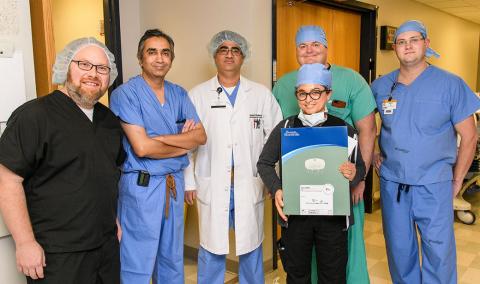
Every minute counts during a heart attack. Our team delivers lifesaving treatment nearly twice as fast as the national goal, helping protect your heart and improve your recovery.
A heart attack is a medical emergency — and getting fast, expert care can save your life.
Heart attacks happen when a coronary artery becomes severely narrowed or completely blocked. Without oxygen-rich blood, part of your heart muscle can become damaged. This is known as a heart attack, or myocardial infarction.
At MU Health Care, we’re ready the moment you need us. As a Level I STEMI center — the highest designation in Missouri for treating the most severe heart attacks — you’ll have 24/7 access to heart specialists and a coordinated emergency response system that often begins even before you arrive.
On average, our team performs lifesaving percutaneous coronary intervention (PCI) in just 47 minutes after you arrive at the hospital. This is nearly twice as fast as the national goal of 90 minutes. PCI is a minimally invasive procedure that opens blocked arteries and restores blood flow, helping protect healthy heart muscle and improve recovery.
After your procedure, we’ll support your healing with medication, lifestyle guidance and cardiac rehab — all designed to help you feel better and lower your risk of another heart attack.
Recognizing a Heart Attack
Knowing the signs of a heart attack could save your life.
Heart attack symptoms don’t always look the same, and they don’t always appear at the same time. For some people, the pain is sudden and intense. For others, the warning signs build slowly over time.
Not everyone feels chest pain. In fact, women are more likely to have subtle symptoms like fatigue, lightheadedness, shortness of breath or discomfort in the jaw, back or shoulders.
Call 911 immediately if you notice any of these signs:
- Chest pain or pressure
- Cold sweat
- Fatigue that feels unusual
- Heartburn or nausea
- Pain that spreads to the arm, jaw or neck
- Trouble breathing or feeling short of breath
When to Call for Help
Don’t wait or try to drive yourself. If you think you might be having a heart attack, call 911 right away. The faster you get care, the more heart muscle can be protected.
Risk Factors for a Heart Attack
You may be at higher risk for a heart attack if you have:
If you have any of these risk factors, talk with your doctor about heart screening, lifestyle changes and ways to lower your risk.
How We Diagnose a Heart Attack
At MU Health Care, diagnosing a heart attack starts the moment you arrive.
Every minute matters, so we work quickly to evaluate your symptoms, medical history and risk factors. Then, we use advanced tools to pinpoint the cause and location of the blockage and assess heart damage.
Depending on your situation, tests may include:
- Blood tests: Measure cardiac enzymes like troponin, which rise during a heart attack or due to other causes of heart stress.
- Cardiac CT or MRI (in select cases): Can help screen for plaque in the heart arteries or show signs of reduced blood flow to the heart muscle.
- Chest X-ray: Helps rule out other causes of chest pain and assess heart size.
- Coronary angiography: A minimally invasive procedure that uses contrast dye and X-rays to find (and potentially fix) blocked arteries.
- Echocardiogram (echo): Uses sound waves to show how well your heart is pumping.
- Electrocardiogram (EKG/ECG): A quick bedside test that records the heart’s electrical activity and detects signs of a heart attack.
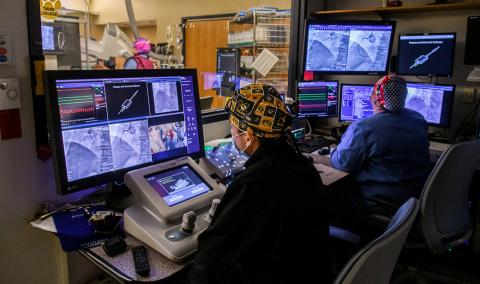
If we confirm a heart attack, our interventional cardiologists perform emergency procedures — often in our cardiac catheterization lab — to restore blood flow and protect your heart muscle from further damage.