Your heart should beat in a steady rhythm. If it flutters, skips or feels out of sync, it could be atrial fibrillation (AFib). MU Health Care offers expert care and treatment options to help protect your heart and support your long-term health.
Atrial fibrillation is the most common type of heart rhythm disorder. It happens when the electrical signals in your heart become irregular, causing the upper chambers (atria) to beat abnormally.
When that happens, your heart may not pump blood as effectively. Blood can pool in the atria and form clots that raise your risk of stroke. Over time, AFib can also weaken the heart muscle and lead to heart failure.
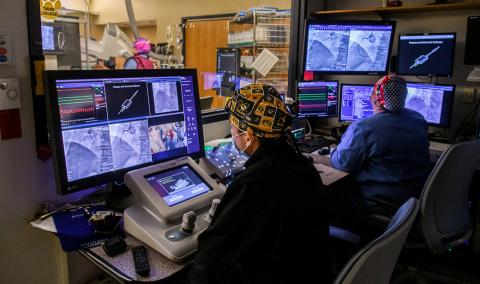
At MU Health Care, our heart rhythm specialists diagnose and treat all types of AFib. Your care team may include electrophysiologists, nurse practitioners, lab staff and device technicians who focus on arrhythmias every day. Your treatment plan will be based on your health history, lifestyle and goals. We use the most advanced options to restore and maintain your heart’s rhythm.
Our Approach to AFib Care
AFib care works best when it’s personalized. At MU Health Care, our specialists in electrophysiology, cardiology and stroke prevention work together to create a care plan that protects your heart and fits your lifestyle.
We focus on helping you understand your condition and feel confident about next steps, whether that includes monitoring, medication or a procedure.
AFib Symptoms
AFib is often linked to conditions that strain the heart, such as high blood pressure, coronary artery disease, heart valve disease or a prior heart attack.
Some people with AFib have no symptoms. When symptoms appear, they may include:
- Fatigue
- Fluttering or irregular heartbeat
- Shortness of breath
- Worsening heart failure
In some cases, the first sign of AFib is a stroke.
When to Call Your Doctor
If you’ve been diagnosed with AFib, it’s important to see a cardiologist who specializes in heart rhythm disorders (an electrophysiologist).
Talk with your doctor if you notice new or worsening symptoms that affect your daily life. Call 911 or go to the emergency room if you experience sudden chest pain, trouble breathing or signs of a heart attack.
Types of AFib
AFib affects everyone differently. Some episodes are brief, while others last longer or become constant. Knowing your type helps guide your care.
- Paroxysmal AFib: AFib episodes that start and stop on their own, usually within seven days. Many last only a few hours or days.
- Persistent AFib: Lasts longer than seven days or needs medicine or a procedure to get the heart back into a normal rhythm.
- Long-standing persistent AFib: Continuous AFib that lasts 12 months or more.
- Permanent AFib: Long-term, continuous AFib that is considered non-treatable.
Valvular vs Nonvalvular AFib
Your care team may characterize your AFib as valvular or nonvalvular, depending on your heart’s structure.
- Valvular AFib occurs when you have rheumatic mitral stenosis or a mechanical heart valve.
- Nonvalvular AFib is AFib without those conditions. Stroke prevention strategies may differ, and if you aren’t a candidate for blood thinners, we may recommend a left atrial appendage closure procedure to reduce stroke risk.
Your doctor may also monitor how much time your heart spends in AFib and adjust your treatment plan as needed.
How We Diagnose AFib
At MU Health Care, we use a full range of tools and methods to diagnose AFib and identify its causes.
We start by talking with you about your symptoms, reviewing your health history and understanding your risk factors.
Based on your needs, we may recommend one or more of the following tests to make a diagnosis:
- Ambulatory monitoring: Holter monitors, event monitors or implantable loop recorders capture off-and-on episodes over time.
- Blood work: Checks electrolytes, thyroid levels and other markers that may affect your heart rhythm.
- Cardiac CT: Assesses heart structure and veins used in ablation planning.
- Cardiac MRI: Evaluates heart muscle and scarring.
- Echocardiogram (echo): Uses sound waves to check heart chambers, valves and pumping strength.
- Electrocardiogram (EKG/ECG): A quick test to document an AFib rhythm.
- Electrophysiology study: Creates a detailed electrical map of your heart when more precise guidance is needed.
- Genetic screening: May be recommended if an inherited rhythm condition is suspected.
- Sleep study: Helps diagnose sleep apnea, a common trigger of AFib.
- Stress testing: Evaluates how your heart performs during activity if AFib doesn’t appear at rest.
- Wearable devices: Some people first notice irregular rhythms on smartwatches. Newer Apple, Samsung and Garmin devices can record single-lead ECGs that help flag AFib.