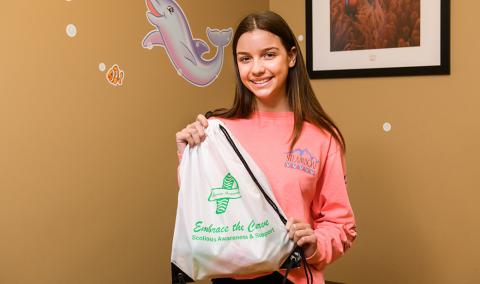
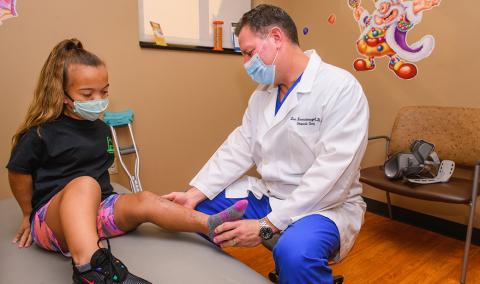
If your child has been diagnosed with scoliosis — or you’re concerned they may have it — our pediatric orthopaedic team offers expert evaluation and advanced treatment options.
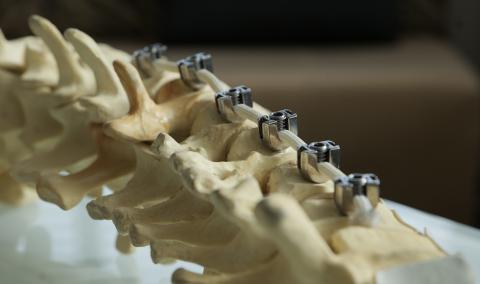
Scoliosis is an abnormal curvature of the spine that usually appears during your child’s growth spurt at or around the time of puberty. On an X-ray, their spine may look like an “S” or a “C,” rather than a straight line.
Pediatric orthopaedic specialists at Children's Hospital are here to help you determine the best course of care. Depending on your child's situation, treatment may include observation, bracing or possibly surgery.
Signs and Types of Scoliosis
Here are some common signs you may notice if you or your child has scoliosis:
- Uneven shoulders
- A rib “hump” when bent over
- One shoulder blade sticks out more than the other
- One leg appears longer than the other
The most common form in children is idiopathic scoliosis, which means the cause is unknown. However, other types of scoliosis can occur in kids with genetic disorders or neuromuscular conditions like cerebral palsy.
How to See Our Scoliosis Specialists
Diagnosis involves a detailed history, examination and often X-rays to determine the spine's curvature, or Cobb angle.
The Cobb angle measures the area of the spine with the greatest tilt and determines the severity of your child's scoliosis and ultimately his or her treatment options. A Cobb angle of 10-25 degree is considered mild, 25-40 indicates moderate and an angle of greater than 45 degrees is severe.
Scoliosis Treatment
Our pediatric orthopedic surgeons provide expert diagnosis and treatment for scoliosis in children and teens. Families from across Missouri and beyond come to Children’s Hospital for spinal care. To schedule an appointment or request a second opinion, contact our team directly.
As part of MU Health Care, our orthopedic surgeons also offer care for adults with degenerative (adult-onset) scoliosis. This type of scoliosis is typically caused by age-related changes to spinal anatomy.
How We Diagnose Scoliosis
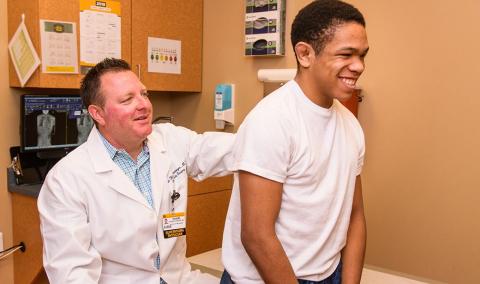
At your child’s first appointment, we’ll ask questions about their medical and family history. We will also perform an evaluation that includes a physical exam and X-rays to determine the spine’s curvature (Cobb angle).
The Cobb angle measures the area of the spine with the greatest tilt and determines the severity of scoliosis. Scoliosis can range from mild to severe:
- 10 to 25 degrees is mild scoliosis
- 25 to 40 degrees is moderate scoliosis
- More than 45 degrees is severe scoliosis
If your child is diagnosed with scoliosis, we’ll discuss treatment options with you and answer any questions you may have.