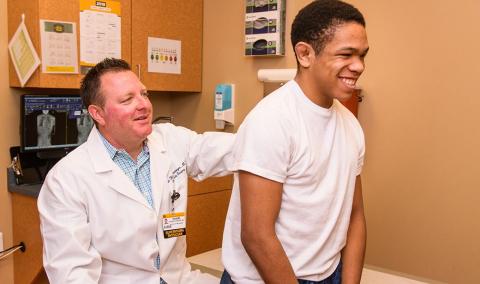
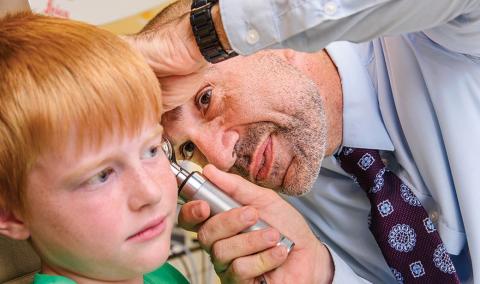
If your baby has a cleft lip or palate, our pediatric plastic surgeons can provide support throughout your child’s development. We can repair the condition during infancy and offer additional support as your child grows into a young adult.
Cleft lip and palate are the most common congenital differences of the head and face. Babies with these differences have gaps in their upper lip or the roof of the mouth.
At Children’s Hospital, our pediatric craniofacial surgeons are highly skilled in caring for kids with conditions affecting the face and skull. Beyond reconstructive surgery, we also offer support to help your child with speech, hearing and other concerns as they develop
Our Team Approach
We provide team-based care to help manage your baby’s various needs. Our pediatric cleft lip and palate experts include:
- Pediatric plastic surgeons: Specialize in craniofacial surgery (skull and face surgery).
- Speech-language pathologists: Can help your child with speech and feeding issues.
- Pediatric ear, nose and throat specialists (ENTs): May help with surgery to close a cleft palate.
- Orthodontists: May assist with aligning teeth and preparation for bone grafting or jaw surgery, if needed.
- Pediatric plastic surgery nurses: Provide education and support for your family.
- Geneticists: Can test your baby for syndromes like Pierre Robin sequence that may cause cleft palate.
- Pediatric mental health specialists: Can help if your child or teen has social or psychological difficulties related to their condition.
- Developmental pediatricians: Can help you manage any growth-related or behavioral issues your child may experience.
- Audiologists: Can test your child for hearing issues that are often associated with cleft lips and palates.
- Dietitians: Can address nutritional concerns in your baby or child.
- Lactation consultants: Provide feeding support and guidance, including breastfeeding and specialty bottle techniques.
- Social workers: Can work with your child’s school to ensure their needs are met in the classroom.
Our goal is to work together on a care plan that is personalized to your child’s needs, no matter their age. For some follow-up visits, we can often coordinate your appointments so you see multiple specialists on the same day.
Signs and Causes of Cleft Lip and Palate
Most babies with cleft lip or palate are diagnosed before birth through ultrasound. Kids with this condition may have:
- A separation or gap within the upper lip only (cleft lip)
- An opening in the roof of the mouth (cleft palate)
- Both a gap in the upper lip and roof of the mouth (cleft lip and palate)
While certain babies may be more likely to develop these anomalies because of genes or their environment, any infant can be born with a cleft lip or palate. While these conditions usually don’t cause pain, they can affect many functions as your baby grows.
Getting Help for Cleft Lip and Cleft Palate
Babies with cleft lips and palates may need care throughout their development. Your OB/GYN, maternal fetal medicine specialist or pediatrician may refer you to our team. Or you can reach out to us directly.
We also provide second opinions if your child was diagnosed at another hospital and you want to know your options.
Types of Cleft Lip and Palate
Our pediatric plastic surgeons have extensive experience treating all types of cleft lip and palate, including:
- Unilateral cleft lip: Occurs on only one side of the upper lip.
- Bilateral cleft lip: Occurs on both sides of the upper lip.
- Complete cleft: The gap spreads from the lip and mouth into the nose.
- Incomplete cleft: The gap does not spread from the mouth into the nose.
- Microform cleft lip: A minor groove or notch in the upper lip.
Cleft lip and palate are more common on the left side than the right side. While it is rare for babies to have gaps on both the left and right sides, our specialists are experienced in treating all variations of cleft lip and palate and can offer the support and care your child needs.