If your baby was born with a cleft hand, our team is here to provide expert care and support. Our pediatric surgeons, hand therapists and specialists work together to help your child gain the best possible function and guide your family every step of the way.
Cleft hand (ectrodactyly) is a rare hand anomaly that is present at birth. It usually creates a gap in the center of the hand, and some children may also have missing fingers or bones.
While cleft hands can run in families, not every baby inherits it from a parent. Genetics may play a role, but the exact cause isn’t known.
Types of Cleft Hand
The two main types of cleft hand are:
- Typical, where the gap in the hand is V-shaped, with part or all the middle finger missing.
- Atypical, where the gap in the hand is U-shaped, with part of all of the index, middle or ring fingers missing.
Cleft hands can be bilateral (affecting both hands) or unilateral (affecting one hand). Babies often have two V-shaped (typical) cleft hands. Children with U-shaped (atypical) cleft hands usually only have one affected hand.
At Children’s Hospital, we treat every type of cleft hand in babies and older kids.
Getting Care for Cleft Hand
Some babies with cleft hands are diagnosed before birth through prenatal ultrasound, while others aren’t diagnosed until they’re born. If your baby has a cleft hand, your OB/GYN, maternal fetal medicine specialist or pediatrician may refer you to us. Or you can contact our team directly.
Our Team Approach
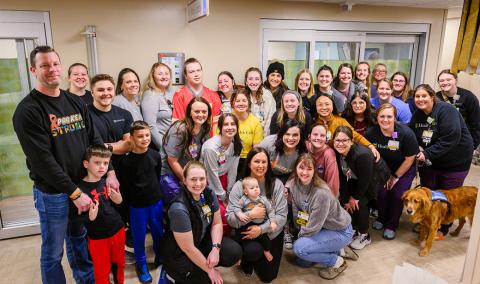
Our cleft hand specialists work together to manage your baby’s various needs as they grow. Your child’s care team may include:
- Pediatric hand surgeons (including pediatric orthopaedic surgeons and pediatric plastic surgeons): Specialize in correcting issues present at birth.
- Certified hand therapists: Provide exercises and other therapies to improve your child’s hand function.
- Orthotists: Can provide custom braces or prosthetics (artificial body parts), if needed.
- Geneticists: Can test your baby for gene mutations that may cause cleft hand.
- Pediatric mental health specialists: Can help if your child or teen needs psychological or social support.
- Developmental pediatricians: Can monitor and treat any growth-related issues in your child.
- Social workers: Can work with your child’s school if they have special needs in classroom.